Overview
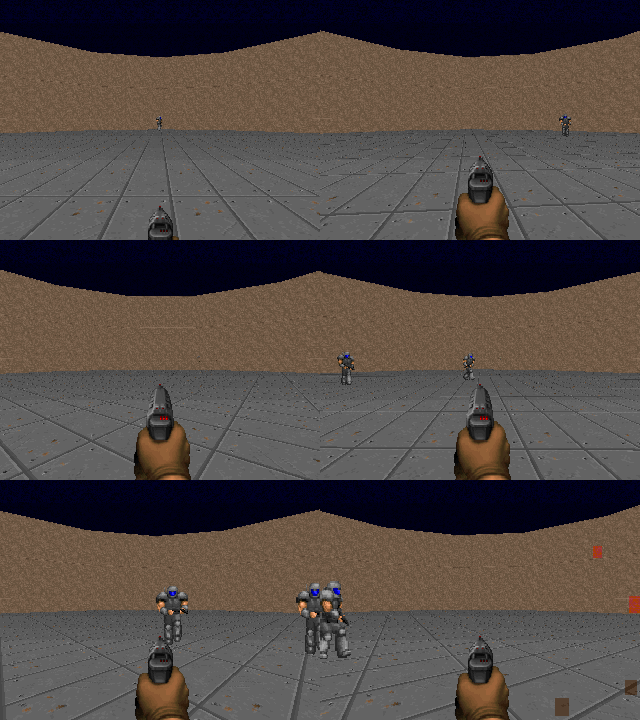
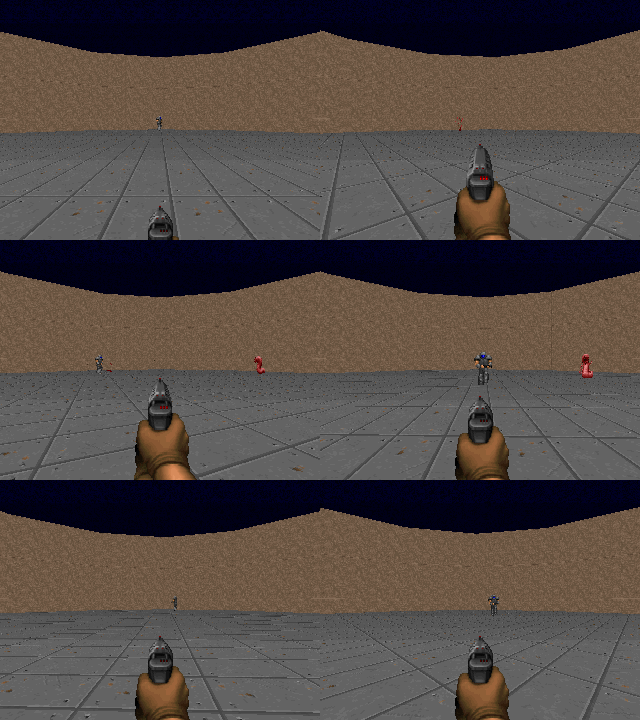
This project trains a Double DQN agent to play first-person shooter scenarios in VizDoom, an RL research platform built on the Doom engine. The agent observes raw RGB frames, encodes them with a frozen pretrained vision transformer, and learns Q-values over a small discrete action space.
The design rests on one idea: the agent should not have to learn to see and to act at once. Large self-supervised vision models (AIMv2, V-JEPA 2) already turn raw pixels into good features. Freeze one, train a small MLP Q-network on top, and training comes out fast, stable, and light on memory.
Key Findings
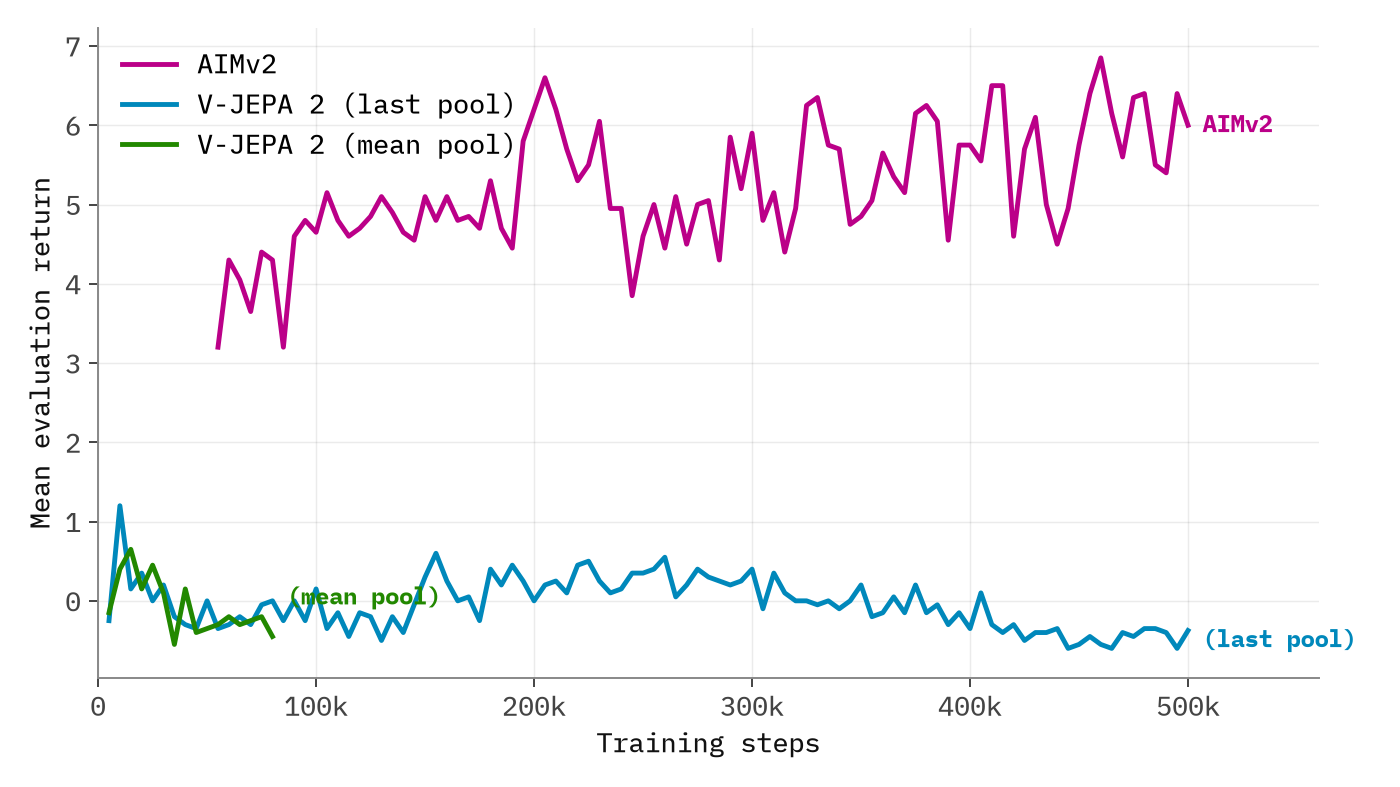
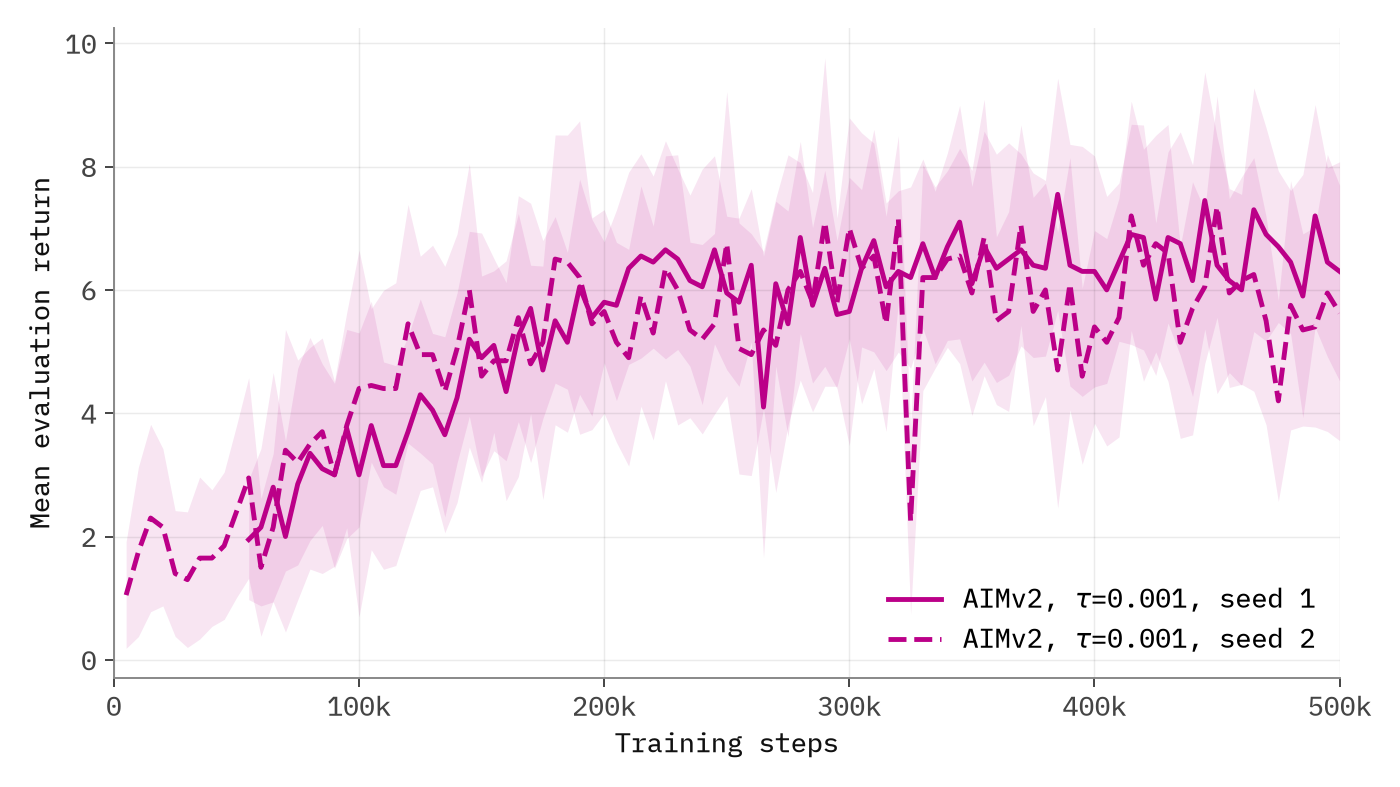
- AIMv2 works — mean evaluation return of ~6 on DefendTheCenter after 500k steps (6.5 and 5.6 across the two seeds).
- V-JEPA 2 diverges — returns never leave zero on either pooling variant, and Q-values run away: past 60 mean / 400 max before the mean-pool run died at 83k steps, past 3,000 mean / 6,000 max over the last-pool run's full 500k. The likely reason: the choppy frame-skip-4 clips look nothing like the video it was pretrained on.
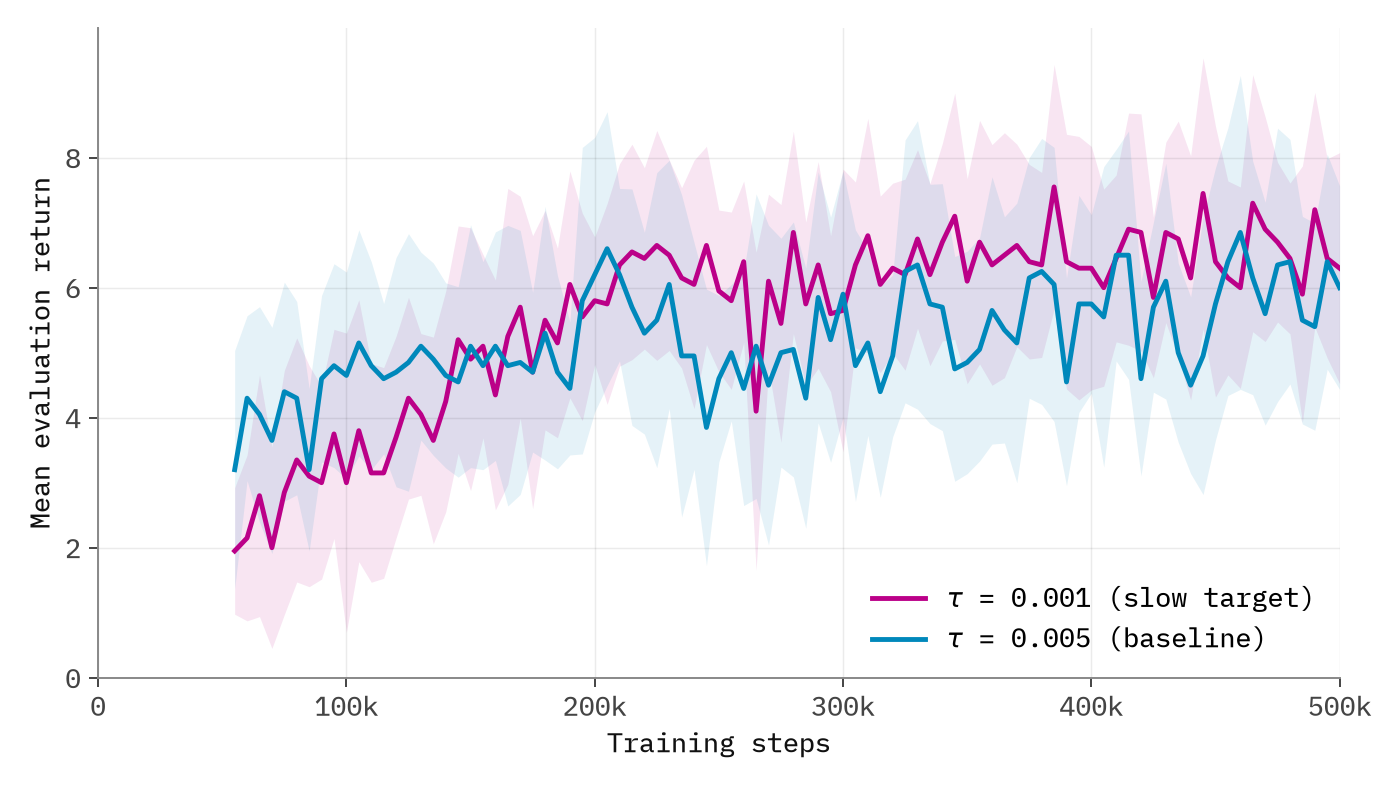
- Slower target updates help — gives slightly higher returns than (6.5 vs 6.1) and keeps Q-estimates in range (peak mean Q of 8 vs 23).
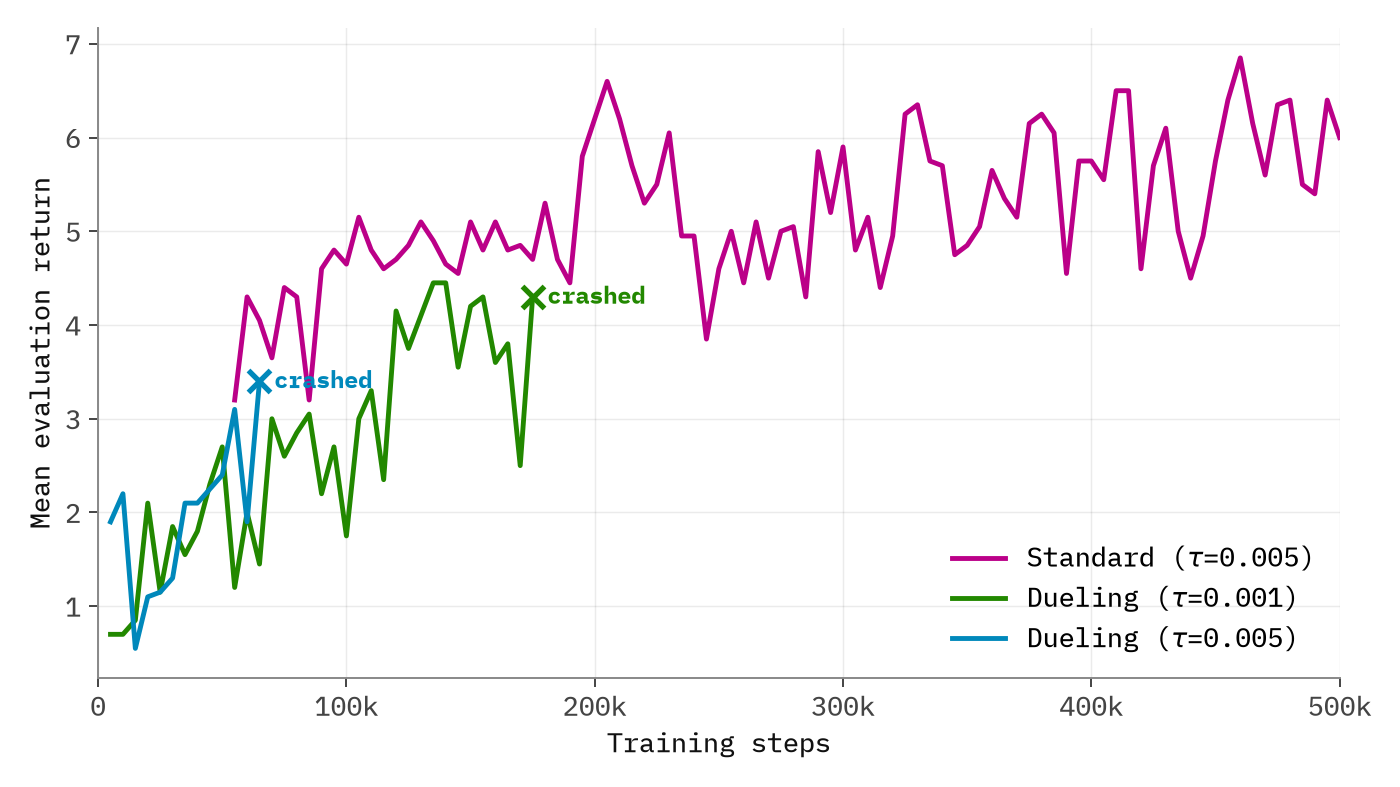
- Dueling is inconclusive — those runs crashed at 66k and 178k steps; up to there the standard Q-network stayed ahead.
Encoder Comparison: AIMv2 vs V-JEPA 2
AIMv2-Large beats V-JEPA 2-Large outright, and neither V-JEPA 2 pooling variant ever leaves zero return. The mean-pool run crashed at 83k steps with Q-values already running away (mean above 60, max above 400). The last-pool run survived all 500k steps and diverged completely: mean Q past 3,000, max past 6,000, returns drifting below zero. The likely cause is the frame rate. V-JEPA 2 was pretrained on video; with frame skip 4, the eight-frame clips it sees here have frames far apart in time, and the smooth motion it expects is gone.
Vision Encoders
The code supports two pretrained encoders:
| Encoder | Source | Input | Patch tokens | Hidden dim |
|---|---|---|---|---|
| AIMv2-Large | Apple | Single 224x224 image | 256 spatial | 1024 |
| V-JEPA 2-Large | Meta | 8-frame 256x256 clip | Spatiotemporal | 1024 |
Both come from HuggingFace Transformers and stay frozen throughout. AIMv2 encodes each frame on its own. V-JEPA 2 reads a sliding window of the last 8 frames; the pipeline averages its spatiotemporal patch tokens over time, then over space, leaving one 1024-dimensional vector per observation.
Feature Pipeline
Raw encoder outputs are 1024-dimensional and unwhitened. Before training, a calibration phase collects observations from a random policy, encodes them in batches, and fits a PCA whitening transform: 1024 dimensions down to , decorrelated, variance normalized. The whitened features then pass through LayerNorm and L2 normalization, and the replay buffer stores the result — 256-dimensional unit vectors.
Q-Network
The Q-network is a 2-layer MLP with hidden size 256, one output per action. An optional dueling variant splits state value from action advantage:
Training
The agent uses Double DQN: the online network picks the action, the target network scores it. After each gradient step, Polyak averaging nudges the target network toward the online one (). Epsilon-greedy exploration, annealed linearly, fills a replay buffer of 100k transitions.
Environment
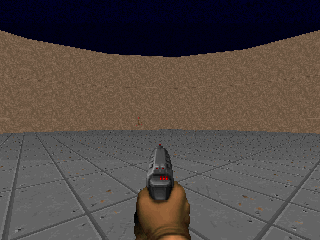
Training uses VizDoom's DefendTheCenter scenario through a Gymnasium wrapper: the agent stands at the center of a circular room, ammunition limited, and shoots enemies as they close in.
Results
All experiments use DefendTheCenter with frame skip 4, a 100k-transition replay buffer, batch size 256, and 500k training steps. Evaluation runs 20 greedy episodes every 5k steps.
Training Curves
Ablation: Target Update Rate
Slower target updates () give slightly higher, steadier evaluation returns than the default ().
Standard vs Dueling Q-Network
The dueling runs never reached 500k steps — they crashed at 66k and 178k. Up to those points the standard Q-network with stayed ahead of both dueling variants (4.9 vs 3.9 at 178k) — though the dueling curves were still rising when they stopped.
Hyperparameters
| Parameter | Value |
|---|---|
| Encoder | AIMv2-Large |
| Feature dim (after PCA) | 256 |
| Q-network hidden size | 256 |
| Q-network layers | 2 |
| Learning rate | |
| Discount | 0.99 |
| Replay capacity | 100,000 |
| Batch size | 256 |
| Target update | 0.001 |
| schedule | 1.0 0.05 over 50k steps |
| Warmup steps | 1,000 |
| PCA calibration steps | 2,000 |
| Frame skip | 4 |
| Total training steps | 500,000 |