Overview
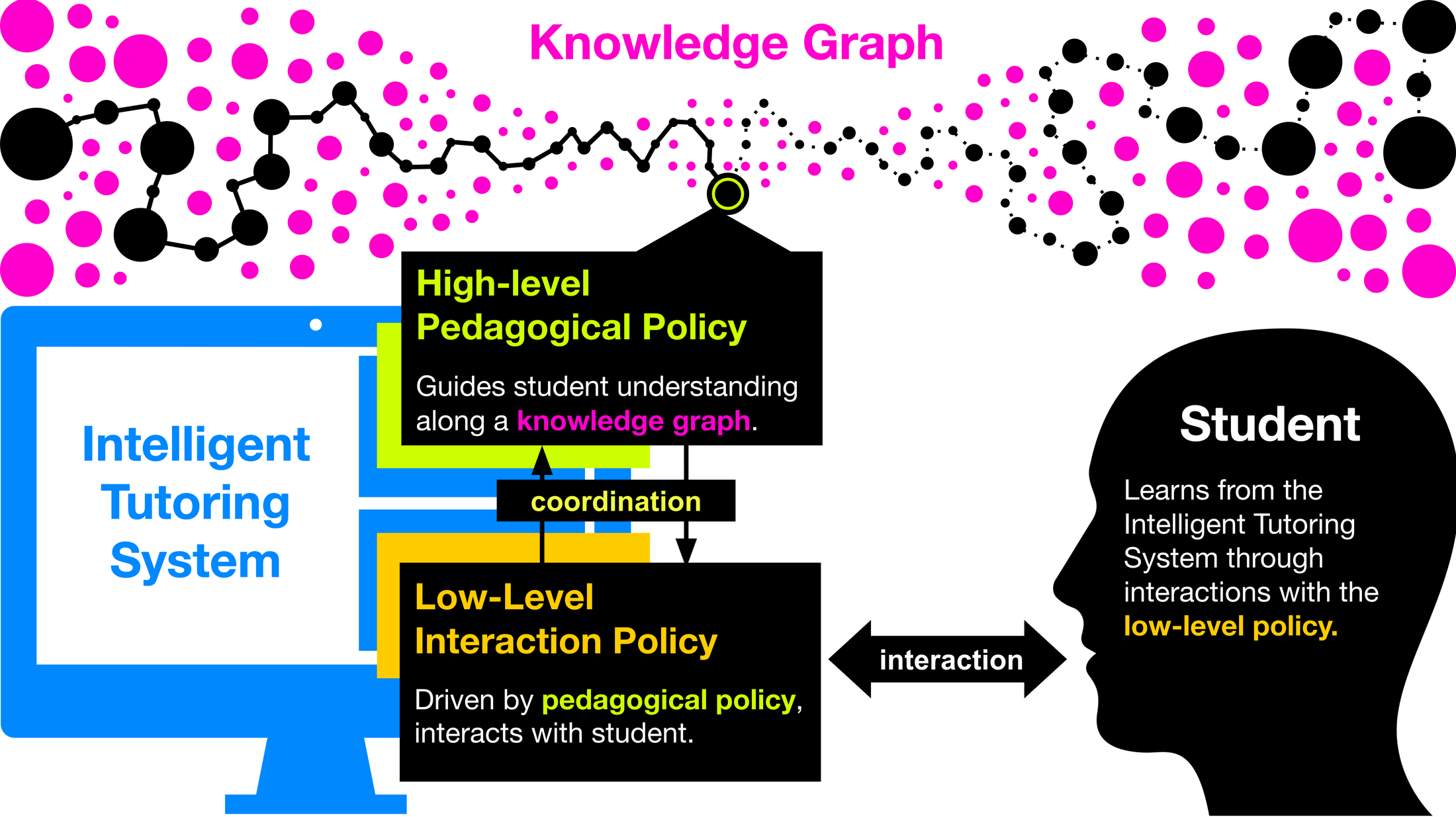
We imagine an intelligent tutoring system as a lightweight pedagogical policy steering a foundation-model interaction layer: the high-level policy decides what to teach next over a knowledge graph, and the interaction layer executes each teaching turn. This paper focuses on the high-level policy. We train it as a Decision Transformer over a Deep Knowledge Tracing world model, instantiate two reward shapes grounded in the learning sciences, and put every comparison through a four-diagnostic screening protocol before believing it.
The result is deliberately negative: the diagnostics caught every comparison between a pedagogically-grounded policy and the immediate-correctness baseline, on both datasets — for reasons ranging from algebraic degeneracy in a reward formula to dependence on the world model's calibration regime. The paper offers no positive claim about either reward shape. Its contribution is the screening protocol itself, paired with a specification of the data infrastructure a faithful evaluation would require.
Setup
Real students appear only as logged data: two primary-school mathematics interaction logs. XES3G5M (18,066 students, 5.1M interactions, 1,175 knowledge components in a four-level hierarchy — the 865 leaf KCs form the action space) is the primary dataset; Junyi Academy (16.2M interactions, 1,326 exercises) is the cross-dataset reproduction target. A K=5 ensemble of Deep Knowledge Tracing LSTMs is fit to each log — reaching test AUC 0.851 on XES3G5M but only validation AUC 0.762 on Junyi, a gap that becomes load-bearing — and wrapped as a Gym-like environment: the state concatenates the reference member's hidden vector with an ensemble-disagreement scalar, and transitions sample synthetic correctness labels from the ensemble mean.
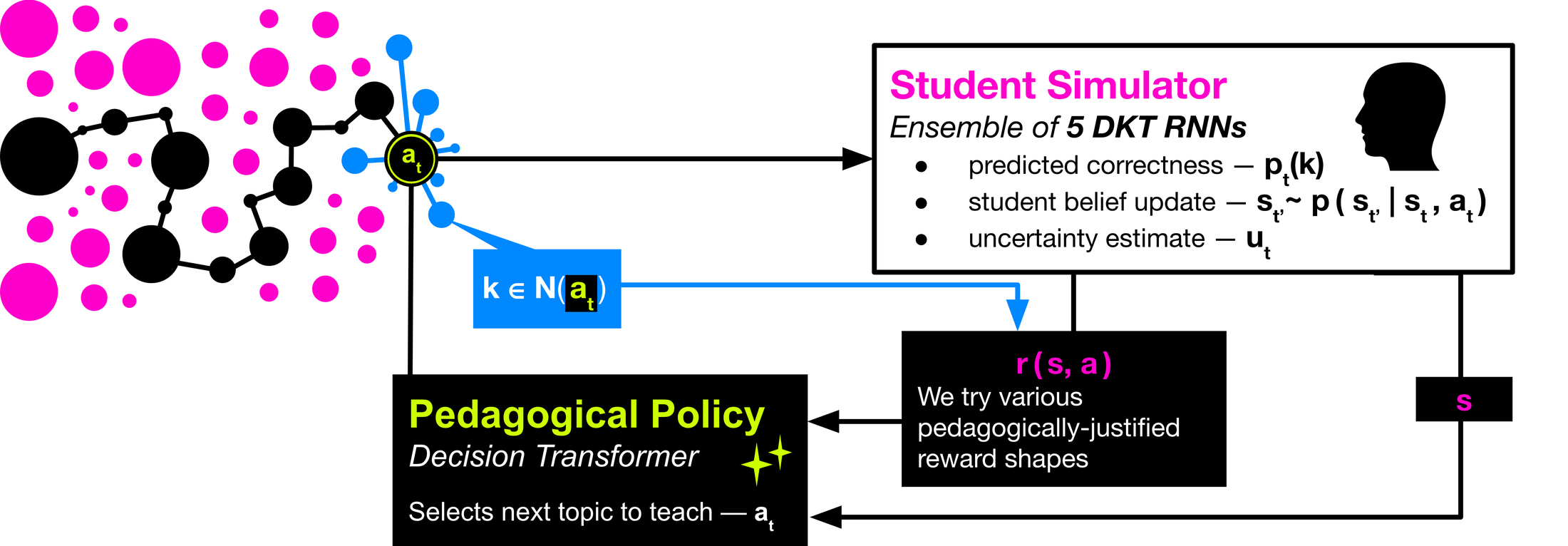
Offline trajectories (10,000 per dataset, horizon 50) come from an ε-myopic-greedy behavior policy (ε = 0.5) rolled out in the world model; Decision Transformers (~1.13M parameters) are trained on them with a MOPO pessimism penalty swept over λ ∈ 2. The pipeline chains real students → world model → synthetic trajectories → policy → off-policy evaluation on real test states — and every link introduces shift. That is precisely why the evaluation needs screening.
Reward shapes
The standard reward in RL-for-tutoring is immediate correctness — teach what the student is most likely to already know:
The learning sciences have argued for thirty years that this is the wrong target. We instantiate two alternatives from distinct traditions. From Preparation for Future Learning, a preparedness-gain reward — the belief change a teaching action induces on the taught topic's sibling neighborhood:
From Productive Failure and the desirable-difficulty literature, a boundary-of-capability reward that targets the moderate-difficulty band:
A fourth candidate, SIB-MEAN — predicted correctness averaged over the taught topic's sibling neighborhood — serves as a neighborhood-smoothed baseline alongside IMM.
The screening protocol
Four diagnostics wrap every comparison. Each is a reapplication of standard offline-RL or empirical practice — applied as a screening protocol at the reward-design stage, rather than after results are reported.
- Cumulative-return correlation precondition — a candidate reward whose return-to-go ranks trajectories like the baseline's produces a mechanically equivalent return-conditioned policy, regardless of its formula. Computed in five minutes, before any training.
- Action-overlap check — a policy whose actions are out-of-distribution under the logged data inherits inflated FQE from circular Q-bootstrapping; we compare the policy's argmax distribution against the empirical teacher.
- Pairwise inter-policy diagnostic — catches the case where differently-rewarded policies are individually plausible but mutually identical.
- Cross-dataset check — a comparison must survive a dataset switch before it counts as evidence about the policies rather than the world model.
The diagnostics are backed by three off-policy estimators (FQE, WIS, DualDICE), each rank-validated on a tractable HMM toy environment before use, and a 20-seed FQE bootstrap matched to policy-class variance — a 5-seed pilot returned t = 1.34 on a comparison the 20-seed bootstrap returned t = +5.41 on, motivating the budget.
What the diagnostics caught
The precondition fired before a single policy was trained:
| Candidate reward | Corr. with IMM return | Verdict |
|---|---|---|
| SIB-MEAN | +0.9956 | Fails (positive collapse) |
| PF-DIFF (p* = 0.5) | −0.9959 | Fails (negative collapse) |
| PF-DIFF (p* = 0.85) | −0.9325 | Borderline |
| PFL-GAIN | −0.1305 | Passes (orthogonal) |
SIB-MEAN collapses into the baseline because XES3G5M's curriculum tree groups siblings by similarity, not prerequisite direction. PF-DIFF at p* = 0.5 is algebraically anti-correlated with the baseline under myopic-greedy behavior — a consequence of the formula we did not anticipate, caught before training.
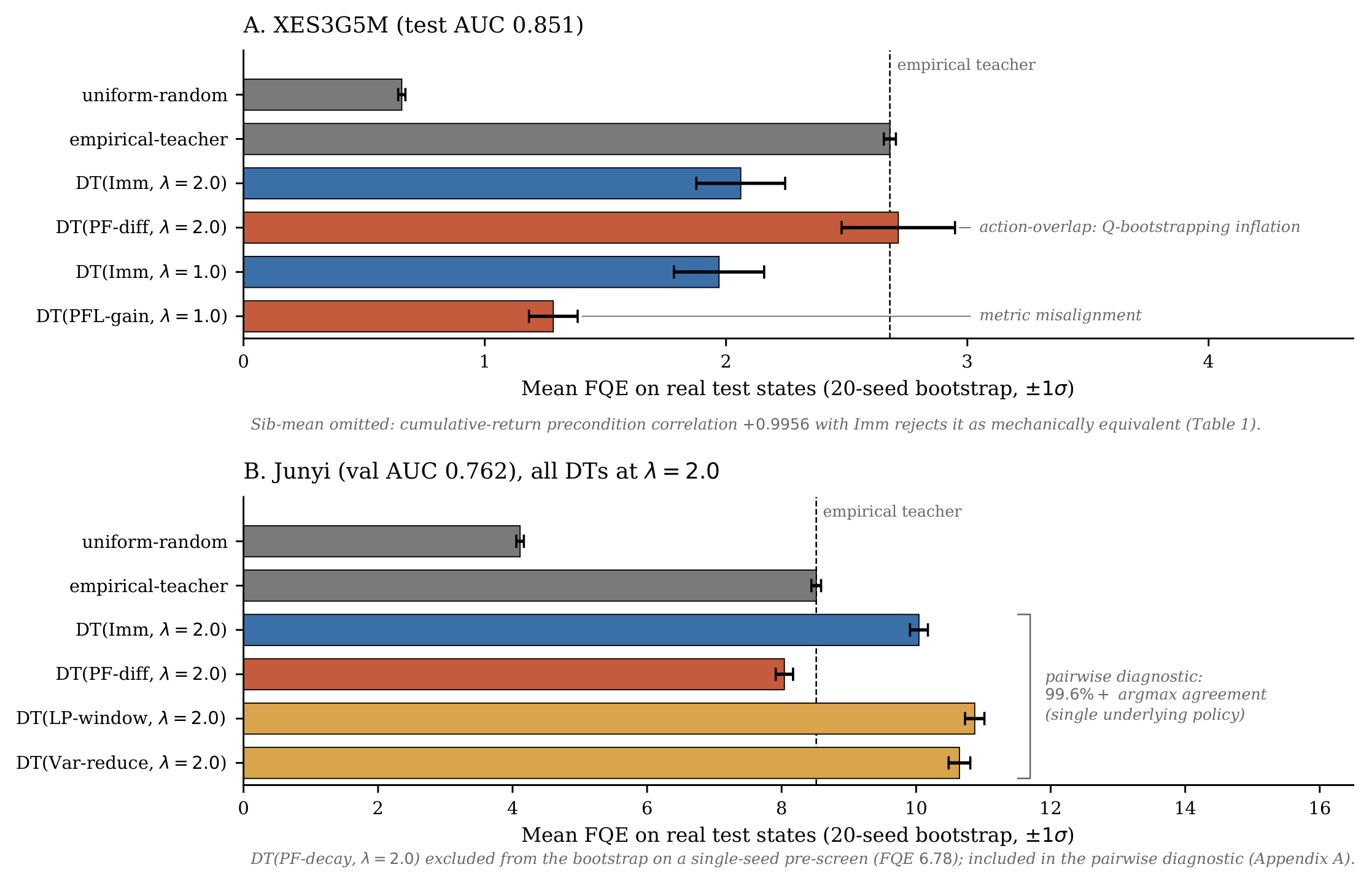
Three catches stand out. On XES3G5M, DT(PF-DIFF) reached the empirical teacher's FQE band (2.714 ± 0.235 vs. 2.679 ± 0.025; the +0.036 difference is below the ~0.10 minimum detectable effect at 20 seeds) — but the action-overlap diagnostic showed 0% argmax agreement with the teacher, 100% zero-overlap on top-5 sets, and a median teacher probability at the DT's argmax below uniform: Q-bootstrap inflation on actions the logged data never covers, worse than CQL, the canonical example of the pathology. On Junyi, the same comparison inverted sign (Welch t from +9.86 to −48.30): the ranking measured the world model's calibration regime, not teaching quality. And the pairwise diagnostic collapsed all five differently-rewarded Junyi policies into one — the bootstrap was measuring FQE evaluation noise on a single underlying policy. Two isolation experiments (filtering trajectories to the top-10% return slice; dropping the MOPO penalty 4×) left policies unchanged at 99.2% argmax agreement, converging on action-space flatness as the load-bearing structural cause across both datasets.
The data infrastructure a faithful evaluation needs
Each catch traces to a missing piece of data infrastructure, which the paper names as the prerequisites for the next attempt:
- A directed prerequisite graph — PFL's transfer construct needs edges a → b; both benchmarks expose only similarity-curated hierarchies.
- A transfer-aligned action structure — hierarchical actions (stay-on-node vs. advance) instead of flat 865/1,326-way argmaxes.
- A post-intervention transfer assessment — PFL's actual metric, absent from every offline pipeline.
- A behavioral anchor outside synthetic trajectories — real-teacher logs, so evaluation has a fulcrum outside the world model.
Takeaway
Offline RL for education inherits every known OPE failure mode, and the standard benchmarks cannot currently support the comparisons the field wants to make. Cheap diagnostics applied before training — correlation preconditions, action-overlap checks, replication across datasets — catch results that would otherwise ship as positive findings. The screening protocol is the contribution; the catalogue of catches is the specification for what to build next.